Forty-eight years after forming in Birmingham, Duran Duran are still finding ways to make the dancefloor feel like their natural habitat. The British new wave pioneers have announced the October 30 physical release of Free to Love: Hot Star Remixes, their first remix album available on vinyl and CD, featuring reworkings from Horse Meat Disco, Trixie Mattel, ALISSIA, DJ White Shadow and several other contemporary dance music artists. Built around the band’s 2026 single “Free to Love,” featuring longtime collaborator Nile Rodgers, the collection also introduces previously unreleased remixes created by Duran Duran themselves.
For a band that helped establish the relationship between pop music, club culture, fashion and visual art during the early MTV era, a remix album feels less like a nostalgic exercise than a continuation of something they helped popularize. Duran Duran were never particularly interested in keeping rock, disco, funk and electronic music in separate compartments. Their greatest commercial successes emerged from a willingness to combine those influences, often while challenging the prevailing idea of what a guitar band was supposed to look or sound like. Nearly five decades later, Free to Love: Hot Star Remixes demonstrates how comfortably that philosophy translates into contemporary dance music.
The original “Free to Love,” released in April, reunited Duran Duran with Rodgers, whose distinctive rhythmic guitar playing helped shape the band’s 1986 hit “Notorious” and its accompanying album. Rodgers’ connection to Duran Duran reaches even further back, including his production work on “The Reflex” remix and “The Wild Boys” in 1984. His presence on “Free to Love” is particularly appropriate considering how much of the band’s musical identity owes to the intersection of new wave and Black American dance music, particularly disco, funk and R&B.
Described as a euphoric, funk-driven anthem, “Free to Love” belongs to the tradition of Duran Duran songs that prioritize movement without sacrificing melodic sophistication. Its combination of rhythmic propulsion, disco influences and polished synth-pop provides an unusually adaptable foundation for remixers. Rather than asking artists to reinterpret an introspective ballad or a conventional rock recording, the band has handed them a track already designed for the dancefloor, inviting each producer to explore a different aspect of its rhythmic possibilities.
The selection of remixers is arguably the most interesting part of the project. Horse Meat Disco, the London-based DJ collective celebrated for its deep relationship with disco and queer nightlife, brings a particularly fitting perspective to a band whose early career unfolded alongside Britain’s flourishing club scene. Their involvement connects Duran Duran’s musical history to contemporary dancefloors where disco has remained a living culture rather than a retro novelty.
Trixie Mattel offers another compelling crossover. Known internationally as a drag performer, musician and DJ, Mattel represents a generation of artists for whom pop music, queer performance, nightlife and personal style are inseparable. Her participation introduces another dimension to the project, reflecting how Duran Duran’s longstanding fascination with image and performance continues to resonate beyond conventional rock audiences.
Additional contributions from Harrison, BastienkHz, ALISSIA, Biff Chitlins and DJ White Shadow broaden the collection’s stylistic reach. The remixers represent different approaches to dance music, from disco-informed production to electronic club sounds, making the album an opportunity to hear how a single composition can be reshaped for different audiences and environments. The press materials do not provide detailed sonic descriptions of each remix, but the range of contributors suggests that the project is intended to function as more than a collection of minor variations on the original recording.
What distinguishes Free to Love: Hot Star Remixes from an ordinary remix package is Duran Duran’s decision to contribute their own previously unreleased interpretations. “Love Overture” and “Across the Galaxy” appear on the standard physical editions, while a third exclusive version, “Spaghetti Exit,” is reserved for the deluxe package. These additions position the band as active participants in the reinterpretation of their music rather than simply handing over the original recording to outside producers.
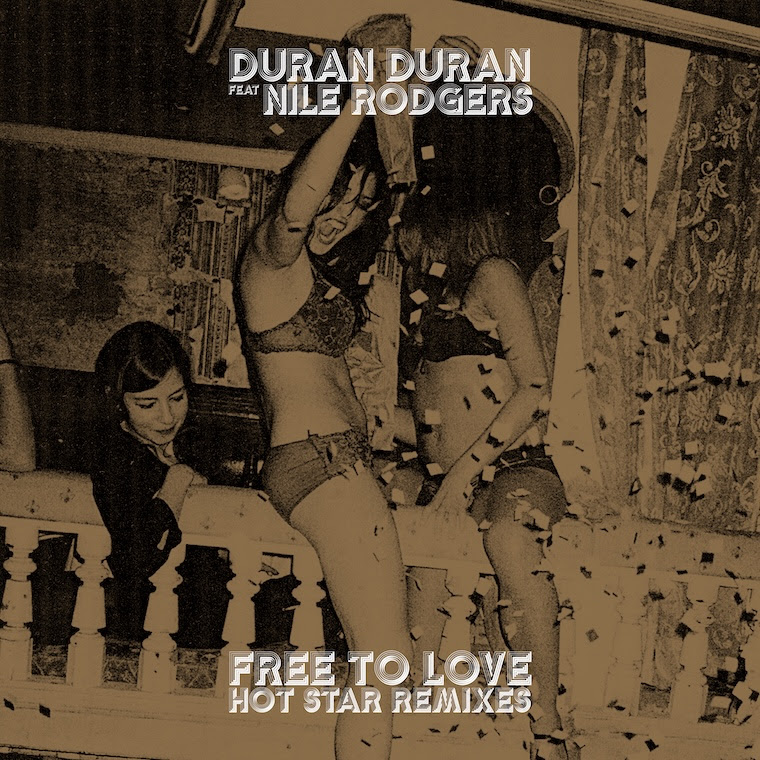
The physical presentation is equally deliberate. Designed by Rory McCartney, the collection features original photography by keyboardist and co-founder Nick Rhodes, with different metallic inks distinguishing the CD, standard vinyl and special edition vinyl. The CD and standard vinyl packages include additional photography booklets, while the deluxe edition features two double-height foldout booklets attached to its gatefold sleeve.
Rhodes’ involvement is worth noting because visual presentation has never been incidental to Duran Duran’s identity. Long before social media turned album artwork and fashion imagery into constant promotional opportunities, the band understood that music could occupy a much larger visual world. Their early music videos were central to the rise of MTV, while their artwork, photography and styling helped establish an aesthetic that remains recognizable decades later. Giving Rhodes’ photography a prominent role in the physical release preserves that creative continuity.
The deluxe edition also makes a particularly direct appeal to vinyl collectors. Available exclusively through the band’s official webstore, it pairs the 10-track remix LP with a bonus seven-inch featuring the original “Free to Love” and “Spaghetti Exit.” One randomly selected deluxe package will contain a gold ticket awarding its recipient Duran Duran’s complete discography on vinyl.
It’s a clever piece of collector marketing, but it also reflects a larger shift in how established artists package recorded music. Streaming makes individual tracks instantly accessible, while physical releases increasingly need to offer something that cannot be reproduced through a playlist. Exclusive recordings, distinctive artwork, limited editions and collectible packaging provide fans with a reason to own music in a tangible format. For Duran Duran, whose audience spans multiple generations of record buyers, the strategy is particularly well suited.

The release arrives amid another busy period for the band. Following their second headlining appearance at BST Hyde Park earlier this summer, Duran Duran are preparing for their first full UK tour in three years, including a Halloween performance at London’s O2 Arena on October 31. The itinerary also extends across Europe, with dates scheduled in Germany, France, Portugal, Norway, Belgium, Sweden and Spain.
There’s a satisfying historical symmetry in Duran Duran returning to dance music at a moment when disco, house, synth-pop and new wave continue to influence mainstream pop. The group’s original success depended partly on its ability to absorb emerging sounds without losing its identity. Now, contemporary producers are approaching that same musical vocabulary from different directions, creating a conversation between the band’s formative influences and the scenes those influences helped inspire.
Free to Love: Hot Star Remixes isn’t a reinvention of Duran Duran, nor does it need to be. Its appeal lies in recognizing that the band’s relationship with dance music has never really ended. The October 30 release offers an opportunity to hear that relationship through the ears of a new generation, while reminding listeners that Duran Duran were making music for the dancefloor long before nostalgia became part of the conversation.
Free to Love: Hot Star Remixes arrives October 30 on CD, standard vinyl and limited-edition deluxe vinyl. Physical editions are available for preorder through Duran Duran’s official channels.
Featured image credit: STEPHANIE PISTEL