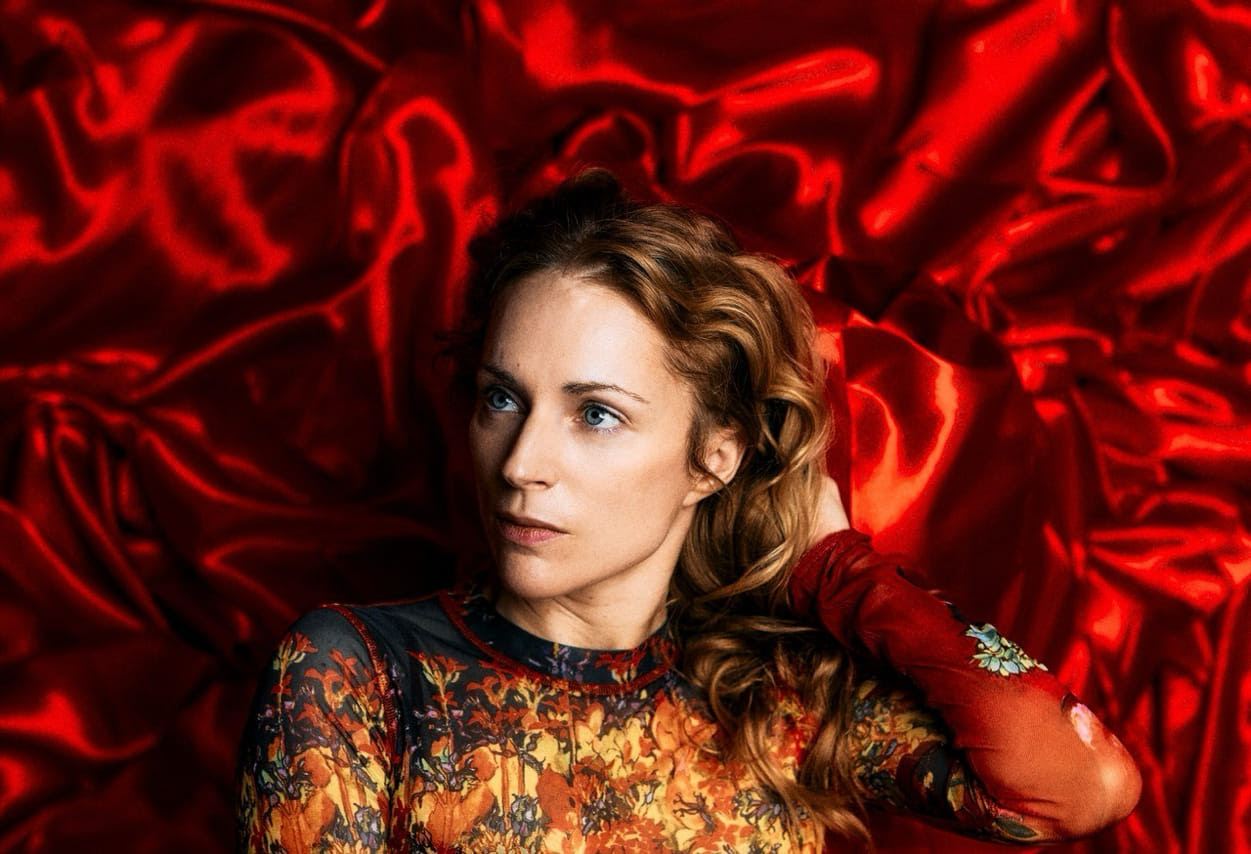
After six years away from the album format, Danish singer-songwriter, composer and producer Agnes Obel will return September 18 with The Meaning of Flowers, a 12-track meditation on birth, motherhood, metamorphosis and the profound rearrangement of self that can accompany bringing new life into the world.
The album, due via Deutsche Grammophon, follows 2020’s Myopia and arrives after a period in which Obel became a mother for the first time. Rather than simply writing an album about motherhood, however, Obel appears to have used the experience as an entry point into a much larger question: what happens to one’s understanding of individuality when the boundaries between the self and another living being suddenly become less clear?
That question runs through The Meaning of Flowers, which Obel wrote, recorded, arranged and produced herself at her Berlin studio. She performs vocals, piano, keys, synthesizers and samples, with additional musicians contributing violin, viola, cello, bass, lap steel, harmonium, flute, saxophone, percussion and backing vocals.
The first glimpse arrives with new single “Laymelli,” an atmospheric piece partly inspired by Enheduanna, the ancient Mesopotamian poet widely regarded as the world’s earliest known named author. Enheduanna’s writing also informs “Blood so Red” and “Gemini,” connecting Obel’s own experiences of pregnancy and childbirth with ideas about the body, creation and transformation that reach across thousands of years.
That intellectual framework is unusually extensive. While making The Meaning of Flowers, Obel immersed herself in philosophy, poetry, fiction and ecological writing, drawing from Hannah Arendt, Emanuele Coccia, Octavia Butler, John Cage, Inger Christensen and others.
Arendt’s concept of “natality,” or humanity’s capacity for new beginnings, became particularly important after the birth of Obel’s daughter. Obel also became interested in the temporary changes to neuroplasticity associated with pregnancy, considering the ways her altered state affected both thought and composition.
“I wanted to see if I could get close to the feeling of a new beginning,” Obel says of the album’s title track. “It shows itself in the experience of interconnectedness and a new expansive feeling of love that will never end.”
That idea of interconnectedness expands The Meaning of Flowers beyond autobiography. The album considers human birth alongside the larger processes of the natural world, where beginnings and endings continually fold into one another. Obel drew from Coccia’s The Life of Plants and Metamorphoses, incorporating imagery surrounding seeds and the life cycle of butterflies into an album preoccupied with what it means to become something new without entirely ceasing to be what came before.
On “Blood so Red,” those ideas intersect with Enheduanna’s hymns to Inanna, the Mesopotamian goddess associated with childbirth, love, sexuality, song and war. For Obel, the ancient writing became a way of connecting her own revelations about childbirth with bodily experiences that exist beyond ordinary language and nevertheless connect people across enormous stretches of history.

Musically, The Meaning of Flowers draws from an equally wide field.
“Don’t Look Down” incorporates the influence of 1970s film scores, while “Never Been” reaches toward the Danish pop music Obel remembers from the 1980s and ’90s, particularly its unabashed treatment of love and personal freedom.
“Tangerine,” meanwhile, is the album’s sole instrumental. Saxophone arpeggios mingle with celesta and piano in what Obel describes as a “bubbly new wondrous friendship,” suggesting that an album dealing with such enormous philosophical ideas will still make room for playfulness and sonic curiosity.
That balance has long distinguished Obel’s work. Her music can feel simultaneously intimate and slightly otherworldly, built from acoustic instruments, manipulated voices, negative space and arrangements that often seem to exist somewhere between chamber music, alternative pop and modern composition. The Meaning of Flowers continues that resistance to easy genre classification while expanding the conceptual world surrounding the music.
It also represents Obel’s first studio album since Myopia, the introspective 2020 record that followed Philharmonics, Aventine and Citizen of Glass. Six years later, the circumstances surrounding its successor could hardly be more different.
The central transformation isn’t simply that Obel had a child. It is that the experience appears to have changed the vantage point from which she creates.
Pregnancy, birth and motherhood become pathways into questions about biology, ecology, philosophy and consciousness. A seed becoming a plant, a caterpillar becoming a butterfly and a person becoming a parent can all be understood as variations on transformation. The Meaning of Flowers asks what those processes might reveal about the illusion of permanence and the interconnected nature of living things.
Ultimately, the album has one very specific person at its center.
Obel dedicates The Meaning of Flowers to her daughter, “she who has changed me and raised me and taught me so much,” adding that she can already sense how much more remains to be learned.
For an artist returning after six years, the sentiment gives The Meaning of Flowers an appropriate starting point. Agnes Obel isn’t simply returning to the person or musician she was when Myopia arrived in 2020.
She is documenting what happened when life required her to become someone new.
Featured image credit: Alex Brüel Flagstad