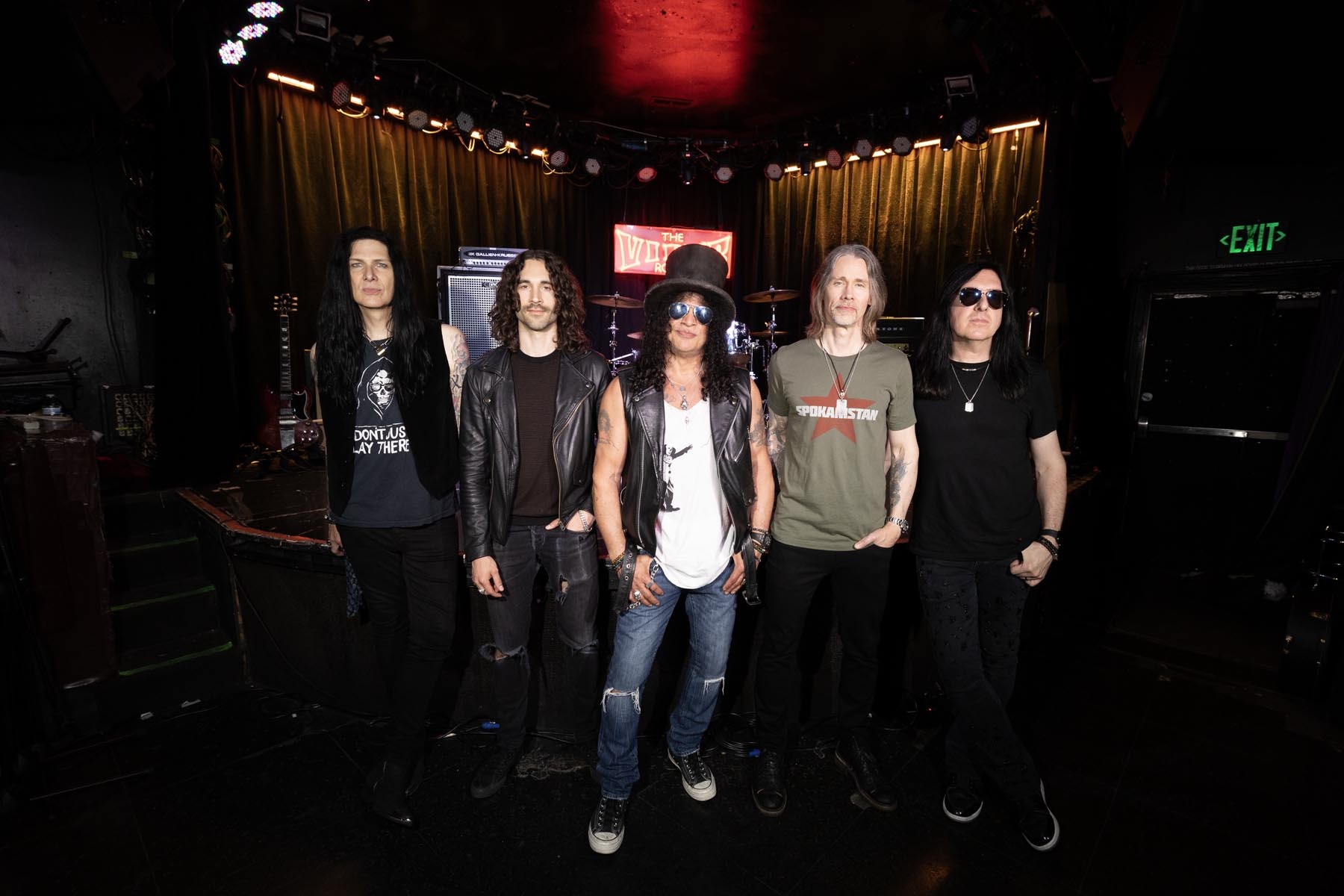
There are plenty of guitarists who can play a Slash riff, but considerably fewer who understand why those riffs work. The Guns N’ Roses guitarist has built a career around an approach to rock music that values feel, melody and instinct as much as technical proficiency. Now, Slash ft. Myles Kennedy and the Conspirators are returning with “Flying Blind,” the title track from their forthcoming fifth studio album, arriving February 26, 2027, through Gibson Records. Accompanied by an official music video filmed at Los Angeles’ legendary Viper Room, the single introduces a record that finds the band returning to the fundamentals of playing together in a room and allowing the music to develop naturally.
The new album marks the group’s first full-length release since 2022’s 4, continuing a partnership that began when Kennedy appeared on Slash’s self-titled solo album in 2010. What initially developed as a collaboration between two established musicians has evolved into one of the more enduring working relationships in contemporary hard rock. Fifteen years later, Slash and Kennedy have maintained their musical partnership despite the demands of Guns N’ Roses, Alter Bridge and their respective solo projects.
“Flying Blind” emerged during pre-production rather than from a fully developed demo. According to Slash, he introduced the initial guitar riff while the musicians were preparing to rehearse, and the arrangement quickly took shape through their collective playing. The guitarist describes the finished song as having the melodic qualities and immediate hook necessary for a lead single, an important distinction for a musician whose reputation rests heavily on creating memorable guitar parts.
That spontaneous beginning is particularly relevant to the song’s musical character. Built around a prominent guitar riff, a flowing chord progression and Kennedy’s soaring vocal melody, “Flying Blind” draws from the band’s established hard rock vocabulary without treating instrumental complexity as an end in itself. The arrangement emphasizes the relationship between the guitar and the vocal, allowing Kennedy’s melody to develop around the momentum established by Slash’s playing.
Kennedy’s lyrics introduce a more reflective dimension. Rather than celebrating reckless abandon, the song examines the temptation to take shortcuts in pursuit of happiness, fulfillment or enlightenment. It’s an interesting subject for a band whose music often communicates confidence and physical intensity. The title suggests uncertainty, but the underlying message concerns the consequences of trying to bypass the experiences necessary for personal growth.
That contrast between muscular instrumentation and introspective songwriting has long been one of the strengths of Slash and Kennedy’s partnership. Slash supplies the instantly recognizable guitar language, while Kennedy’s vocals and lyrics give the songs an emotional architecture that extends beyond their riffs. Their collaboration works because neither musician needs to dominate every moment of a recording.
The official “Flying Blind” video was directed by John Harvatine IV and filmed at the Viper Room in Los Angeles, a venue closely associated with the city’s rock history. It’s an appropriate setting for a band that continues to prioritize the communal experience of live performance. While the Viper Room’s cultural mythology is well established, the choice also reinforces the musical philosophy behind the new record: rock music doesn’t necessarily need elaborate production or technological reinvention to communicate something immediate.
That philosophy shaped the recording of Flying Blind. Working with producer Michael “Elvis” Baskette at Studio Barbarosa in Florida, the band completed most of the 12-track album in approximately one week, frequently recording two songs per day. Slash, bassist Todd Kerns, drummer Brent Fitz and rhythm guitarist Frank Sidoris performed together in the same room, with Kennedy recording his vocals several months later.
Slash reportedly gave Baskette two instructions: capture the band playing as live as possible and avoid excessive adjustments afterward. The approach places greater emphasis on the interaction between musicians than on assembling individually perfected performances through extensive studio editing.
There is an important distinction between a record that sounds polished and one that sounds alive. Modern rock production can achieve extraordinary precision, but that precision sometimes comes at the expense of the small rhythmic variations and spontaneous decisions that make a band feel like a collective organism. By recording together, the Conspirators are attempting to preserve the chemistry that develops when musicians respond to one another in real time.
It’s also worth noting that this isn’t entirely new territory for the group. Their previous album, 4, was produced by Dave Cobb and recorded live at Nashville’s RCA Studio A. The difference with Flying Blind appears to be the combination of an especially compressed recording schedule, the return of Baskette and an emphasis on leaving performances largely untouched. Rather than presenting the approach as a radical reinvention, the band is refining a method that already suits its strengths.
The forthcoming album also promises a broader stylistic range than its straightforward recording philosophy might suggest. “Good Time Girl” incorporates talk box guitar and country influences inspired by Jimmy Bryant and Speedy West, while “Sweet Kill” leans into an overtly 1980s hard rock sensibility. “Here in Babylon” introduces punk-influenced chords, and “One of Your Kind” explores a heavier, down-tuned sound.
One of the most intriguing developments is “Looking for a Miracle,” which features Slash playing pedal steel guitar. Although the instrument has a long association with country music, its expressive possibilities extend far beyond conventional Nashville arrangements. Slash developed the song’s original musical idea on pedal steel before adapting it for the full band, eventually returning to the instrument to record a solo.
For a guitarist whose sound is so closely identified with a particular instrument and playing style, the decision to seriously explore pedal steel is more significant than it might initially appear. Its mechanical complexity and fluid pitch control require a different physical approach from conventional electric guitar. Slash’s willingness to spend time mastering it suggests that, even after decades of international success, he remains interested in expanding his musical vocabulary.
The record’s other tracks offer glimpses of the band’s range. “Thrill Seeker” is built around a descending riff, “Rev My Heart” draws from classic rock and personal memories of Kennedy meeting his future wife, and the instrumental “Living the Dream” provides room for Slash’s improvisational playing. The album closes with “Stem the Flow,” a song addressing disillusionment with institutions and systems once considered dependable.
The timing of “Flying Blind” also reflects the unusual demands of maintaining a long-running band whose members are simultaneously involved in other major projects. Slash developed material while touring with Guns N’ Roses, recording his blues album Orgy of the Damned and organizing the S.E.R.P.E.N.T. Festival. Kennedy worked on the songs between commitments to Alter Bridge and his solo career. Rather than waiting for an extended period of uninterrupted creative freedom, the musicians assembled the album through concentrated sessions whenever their schedules aligned.
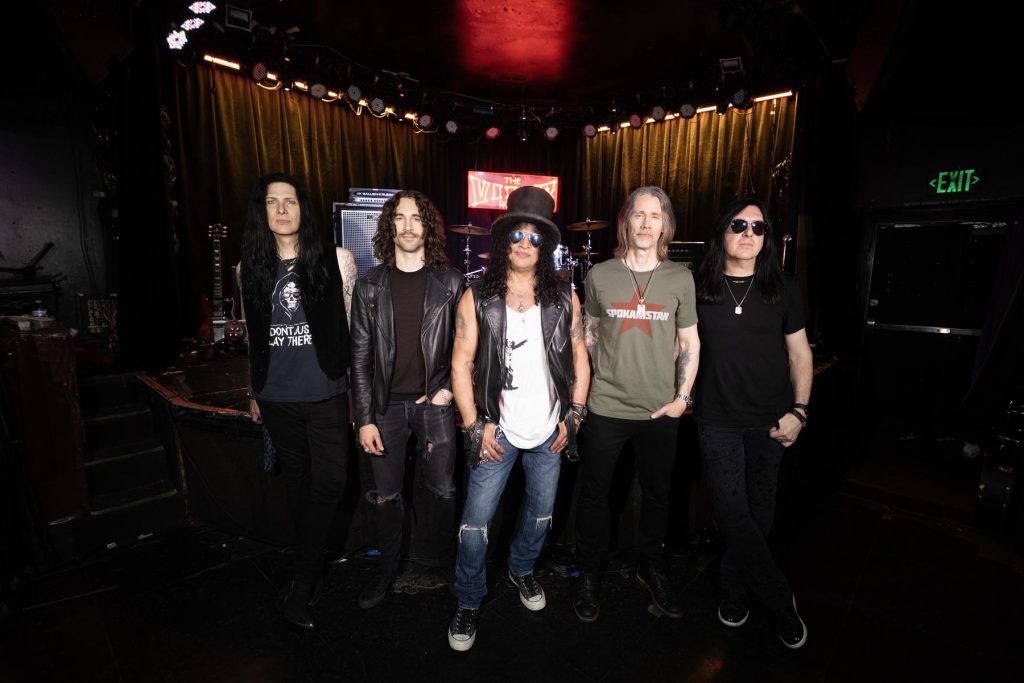
That arrangement says something about the durability of their partnership. What began as an opportunity for Slash to collaborate with a vocalist outside Guns N’ Roses has become a fully developed band with its own identity, catalog and international touring audience. Kennedy, Kerns, Fitz and Sidoris are not simply supporting musicians orbiting a famous guitarist. Their collective chemistry has become central to what makes the Conspirators distinct from Slash’s other projects.
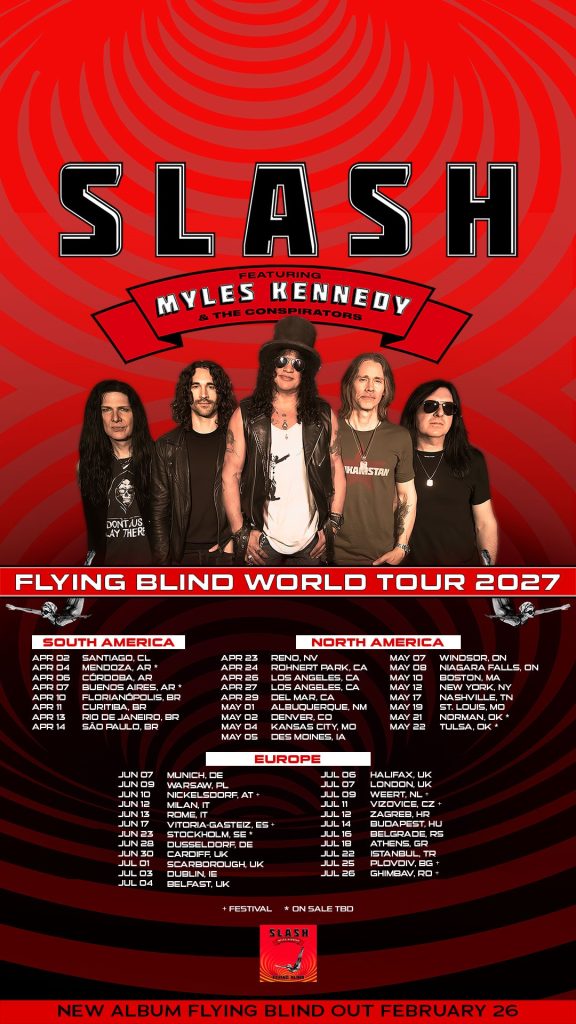
The band will take “Flying Blind” on an international tour beginning in Latin America in April 2027, with North American performances starting April 23 before continuing through the United Kingdom and Europe. Scheduled stops include two nights at the Wiltern in Los Angeles, New York City’s Beacon Theatre, Nashville’s Ryman Auditorium and other established concert venues.
The group has also partnered with Fandiem on a charitable sweepstakes benefiting the American Foundation for Suicide Prevention and the National Alliance on Mental Illness. The campaign offers an opportunity to travel to Wales for a performance at Cardiff Castle, including backstage access and a meeting with Slash, connecting the album campaign to organizations supporting mental health and suicide prevention.
Ultimately, “Flying Blind” is less about proving that Slash can still write an effective guitar riff than demonstrating what happens when that ability is placed within a stable, creatively engaged band. His place in rock history was established long ago, but the Conspirators offer something different from the responsibilities of maintaining an iconic legacy. They provide an environment where five musicians can continue making new music without needing every release to compete with the past.
For listeners who have followed Slash through Guns N’ Roses, Velvet Revolver and his solo work, “Flying Blind” offers another opportunity to hear the guitarist operating within a group that has developed its own musical personality. For younger rock audiences, it offers a reminder that the most compelling guitar music often begins with something considerably simpler than virtuosity: a good riff, a room full of musicians and the willingness to see where it goes.
Featured image credit: Gibson Records