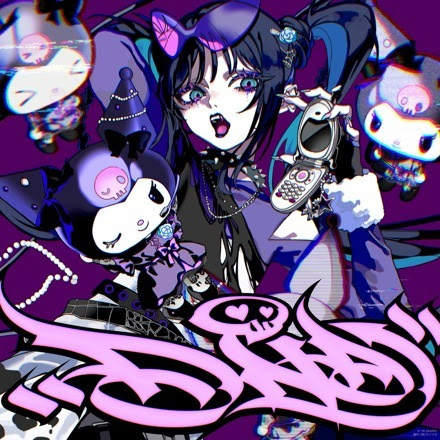
Japan’s powerhouse vocalist Ado has joined forces with Sanrio’s resident troublemaker KUROMI for “DND feat. KUROMI,” a new single that brings together two very different corners of Japanese pop culture with surprisingly similar attitudes toward authority, individuality, and the exhausting business of other people’s expectations. The collaboration is as much a meeting of musical and cultural identities as it is a demonstration of how Japan’s entertainment industry continues to blur the boundaries between music, fashion, animation, and character culture.
“DND,” short for “Do Not Disturb,” is built around the idea of tuning out the noise and pursuing your ambitions without asking anyone’s permission. Written specifically for the collaboration by Asteroid Music Team, the track pairs Ado’s commanding vocal personality with KUROMI’s mischievous attitude over a powerful, beat-driven production. Their energetic vocal exchange plays on the contrast between Ado’s theatrical intensity and KUROMI’s playful defiance, turning a familiar message about self-expression into something that feels like a declaration from two characters who have never been particularly interested in behaving themselves.
The pairing makes considerably more sense when you consider their respective histories. Ado introduced herself to mainstream audiences in 2020 with “Usseewa,” a confrontational anthem that challenged the social expectations imposed on young people in Japan. The song became a cultural phenomenon partly because it articulated frustrations that polite society would rather keep quiet. KUROMI, meanwhile, has spent more than two decades serving as Sanrio’s black-hooded alternative to its traditionally sweet and wholesome characters. With her pink skull, devilish grin, and punk-inspired appearance, she represents a particular kind of rebellion that remains compatible with cuteness. Put them together, and the thematic connection practically writes itself.
What makes “DND” interesting is how that shared rebellious identity translates across two very different entertainment industries. Ado emerged from Japan’s utaite culture, where singers developed audiences by uploading vocal performances online, often maintaining a degree of anonymity. Her extraordinary vocal range, dramatic delivery, and willingness to embrace darker emotional territory helped transform that internet following into an international career. KUROMI belongs to a character-driven commercial universe in which personality, visual identity, merchandise, and storytelling can be just as influential as traditional entertainment releases. Their collaboration illustrates how closely these worlds now intersect.
There is also something amusing about two highly successful commercial properties telling everybody else to leave them alone. Rebellion has always been attractive to the entertainment business, particularly once someone figures out how to put it on a T-shirt. But the contradiction doesn’t necessarily make “DND” insincere. If anything, it reflects how thoroughly alternative aesthetics have become part of mainstream Japanese culture. The visual language of punk, goth fashion, and outsider identity no longer belongs exclusively to underground scenes. It exists alongside pop music, collectible merchandise, and globally recognizable characters, often reaching audiences who might never encounter those influences through their original musical contexts.
For Ado, the release continues an extraordinary period of international expansion. Her Hibana World Tour reached approximately 500,000 fans across five continents, according to her representatives, while 2026 has included a Lollapalooza debut and a headlining appearance at Japan’s Summer Sonic Festival. Those milestones matter because Japanese artists have historically faced considerable barriers when attempting to establish sustained careers outside their domestic market. Ado’s international audience demonstrates that Japanese-language music no longer needs to be repackaged in English to find substantial global demand.
Her success also speaks to a larger change in how listeners discover music. Ado’s career has been shaped by online communities, anime-related music, and the circulation of Japanese popular culture beyond Japan. Her recording of “New Genesis” for One Piece Film: Red became the first Japanese-language song to reach No. 1 on Apple Music’s Global Top 100 chart. Collaborating with KUROMI is another extension of that cultural ecosystem, connecting an internationally established singer with a character whose appeal crosses generations and national borders.
Compared with the frustration that defined “Usseewa,” “DND” approaches resistance from a more celebratory perspective. The earlier song challenged the pressure to conform, while the new collaboration presents individuality as something worth enjoying and defending. It is a subtle but meaningful distinction. Ado’s original audience connected with the anger of feeling misunderstood. Five years later, her music can address that same desire for independence through a character whose entire identity revolves around being unapologetically different.
The accompanying collaboration artwork reinforces that connection, depicting Ado with twin tails inspired by KUROMI’s signature black hood. It is a clever visual exchange rather than a complete reinvention of either artist. An official music video is also forthcoming, offering another opportunity to explore how their contrasting aesthetics work together.
Ultimately, “DND feat. KUROMI” matters because it demonstrates that Japanese pop’s relationship with alternative culture is considerably more complicated than the usual distinction between underground authenticity and mainstream commercialism. Ado’s dramatic vocal identity and KUROMI’s mischievous persona occupy different parts of the entertainment business, but both have built their appeal around refusing to fit someone else’s expectations.
Ado hasn’t had to abandon her rebellious identity to enter Sanrio‘s universe. KUROMI is proof that rebellion has been living there all along.
Featured image credit: Ado