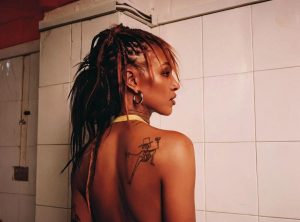
I was prepared to write a completely different article about Troye Sivan’s “She’s the Best.”
When I first heard the song, I was fascinated more than offended. After Something to Give Each Other, particularly the sweaty dance-pop immediacy of “Rush” and “Got Me Started,” I wasn’t expecting Sivan to come back sounding like he had wandered through Beck, King Missile, Butthole Surfers, and the stranger corners of ’90s alternative rock. The loose, spoken-sung delivery caught me off guard, and the more I listened, the more interested I became in the structure of the thing. “She’s the Best” sounded almost deliberately easy to dismantle, full of affirmation-like phrases that could be pulled out, remixed, clipped into TikToks and repurposed as internet content.
I thought that was the story. Maybe this strange song was actually a fascinating example of what “music for TikTok” sounds like when that logic starts influencing songwriting itself.
Then I watched the video, and I stopped caring nearly as much about TikTok.
Because if “She’s the Best” is supposed to be a celebration of women, I have a much more immediate question: Why did watching it make me feel so degraded as one?
I’m not approaching that question from outside the LGBTQ community, either. I am a femme lesbian. I have spent my entire adult life existing in queer spaces and understanding femininity as something much more complicated than long hair, breasts, nails, makeup, dresses or sexual availability. That is part of why the video struck such a nerve with me. I know the difference between loving women and loving an aesthetic idea of Woman, and those things are not interchangeable.
The problem announces itself almost immediately. Sivan’s character watches Nicole Kidman walking down the street through a window, and this supposed ode to women introduces its central female figure with a vulgar reference to semen on her dress.
I’m sorry, but what the fuck does that have to do with celebrating women?
I don’t find it liberating. I don’t find it flattering. I don’t find it particularly clever. And I’m not interested in being told that reducing a woman to a cum-stained dress somehow becomes sophisticated because it exists inside a queer, camp or sexually transgressive piece of pop art. A man looking at a woman and immediately projecting semen onto her clothing is not some revolutionary new way of talking about women. Sexual degradation of women is ancient.
Kidman’s character is simply walking through the world. Before we know anything meaningful about her, Sivan’s narration has already imposed somebody else’s sexual act onto her body. Why? What does that tell me about her intelligence, humor, resilience, power, beauty or character? What does it tell me about womanhood? If the joke is simply that it is vulgar and unexpected, then once again a woman’s body has been volunteered as the setup for somebody else’s transgression.
And I cannot stop thinking about the double standard.
What would happen to a female pop star who opened her supposedly empowering new era by singing about herself casually walking around with semen on her clothes? Would everybody call it witty, provocative and liberating? Or would that image follow her for the rest of her career? Would it appear in comment sections every time she tried to discuss something serious? Would it become evidence that she was trashy, attention-seeking, promiscuous or incapable of demanding respect?
Women know the answer because women live with that double standard constantly. Female sexuality can sell records, generate clicks and entertain audiences, but women themselves are still routinely punished for appearing too sexual, too vulgar or too comfortable with their own bodies. The culture consumes sexualized women enthusiastically and then turns around and judges those same women for allowing themselves to be consumed.
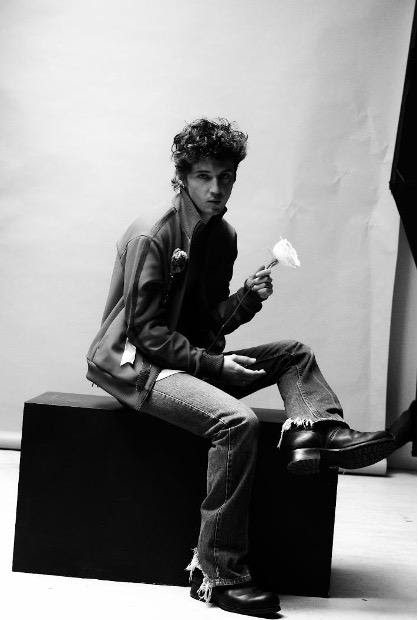
Now make the hypothetical woman Megan Thee Stallion.
Imagine somebody released a song supposedly honoring Megan and one of the first things he told us about her was that she was walking down the street with a cum stain on her dress. Would we seriously discuss that image exclusively as cheeky sexual liberation? I doubt it. The history of Black women being hypersexualized and fetishized would immediately become relevant. We would understand that sexual imagery does not arrive in a vacuum, and that the identity of the woman being described affects the historical baggage attached to it.
I am not accusing Sivan of racism for a lyric directed toward Kidman. I’m asking whether anybody involved in constructing this supposedly celebratory statement interrogated its sexual politics deeply enough. Race changes the history surrounding sexual stereotypes. Class changes it. Age changes it. Celebrity changes it. If an image becomes obviously troubling the moment we imagine applying it to a woman whose race makes the history of sexual stereotyping impossible to ignore, perhaps the underlying image deserved more scrutiny in the first place.
Did anybody think this through?
Did anybody at the label watch this entire thing and ask what it was actually saying about women rather than what everybody involved intended it to say? Did anyone ask whether an ode to women should begin by putting semen on a woman’s dress? Did anybody imagine replacing Nicole Kidman with a Black woman, an unknown woman, a working-class woman, or simply a woman without Kidman’s extraordinary cultural power and ask whether the image suddenly felt uglier?
Because the opening is not an isolated provocation. The longer I watched, the more it began to feel like an introduction to the video’s entire problem.
Women are everywhere in “She’s the Best,” but the visual vocabulary used for ordinary female existence struck me as remarkably bleak. Women are shown through aging, exhaustion, economic struggle, cigarettes, vaping, public transportation and sexual situations. They look tired. Some look worn down. Some are sexualized. Others barely receive identities at all. Even professionally trained ballet dancers, women whose bodies represent years of extraordinary discipline and sacrifice, become largely faceless, anonymous components of the composition. We see their legs, costumes, choreography and the shapes their bodies make, but comparatively little interest in the women inhabiting those bodies. Their expertise becomes texture.
None of these things is inherently degrading. Women ride buses. Women vape. Women smoke. Women work exhausting jobs. Women age. Women struggle financially. Women have sex. Women can be promiscuous, celibate, glamorous, disheveled, wealthy, broke, exhausted, brilliant, boring or ecstatic.
That is not my complaint.
My complaint is that this is a video supposedly celebrating us.
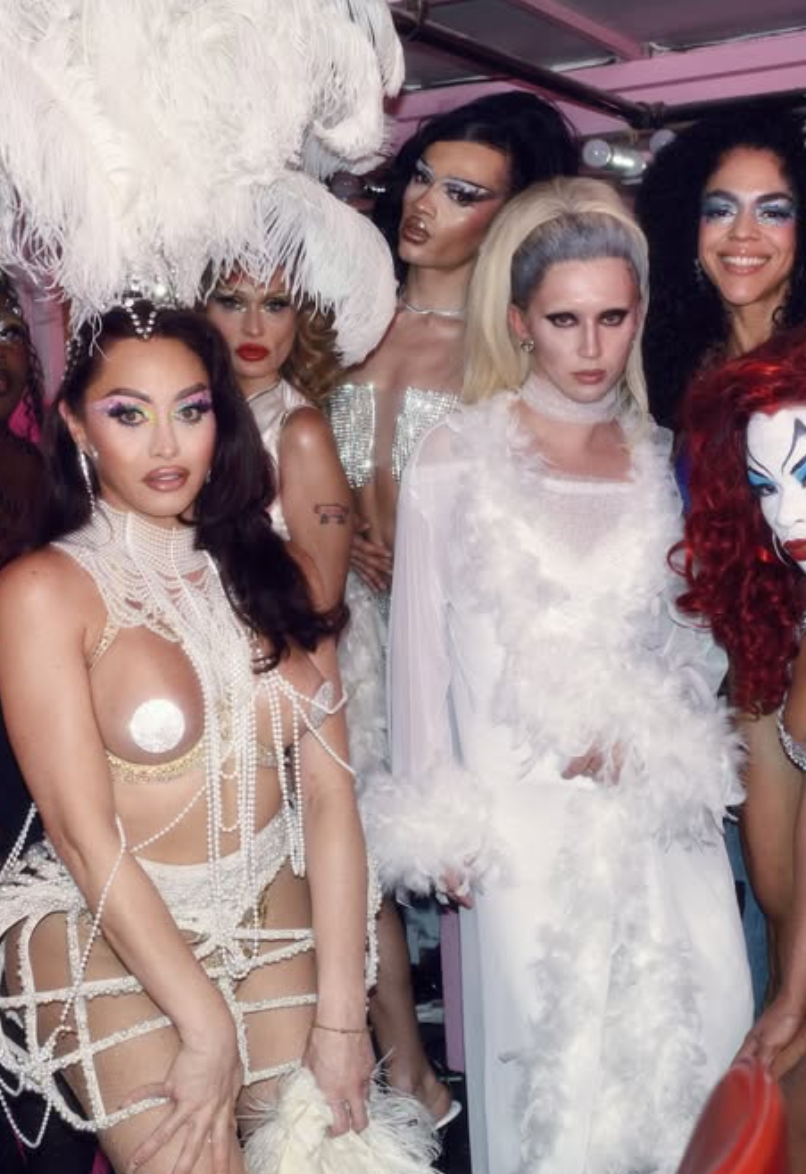
Where are the ordinary women who are thriving? Where are the women with jobs they love? The women creating things? The women who are funny, successful, brilliant or powerful without being transformed into fantasies? Where are the female friendships, careers, ideas and interior lives? Where are women simply existing without their bodies becoming evidence of sex, age, exhaustion, poverty or somebody else’s aesthetic concept?
Why, in an ode to women, does ordinary female life so often look miserable?
Because the moment femininity becomes fantasy, everything changes. And there is one woman in particular whom Sivan’s character actually bothers to see.
Nicole Kidman.
Kidman is not treated like the anonymous women passing through the rest of the video. She is not a pair of legs performing choreography. She is not an exhausted commuter, a sexual body, a woman vaping on public transportation or another piece of scenery in somebody else’s visual universe. She gets a face. She gets sustained attention. She gets mystery, glamour, desirability and narrative importance. Sivan watches her through the window, follows her with his eyes and studies her with an intensity that gradually turns her into something larger than a person. She is pedestalized to an almost absurd degree.
And then we discover that she can give him something.
That detail changes the dynamic for me. The woman Sivan’s character seems genuinely interested in, the woman he elevates above the others and spends the video fixated upon, ultimately serves his narrative. By the end, Kidman occupies something like a Creatrix role, helping bring his new feminine image into existence. She has something he wants. She can facilitate something he needs. Suddenly, his fascination with her no longer reads to me as uncomplicated reverence. I find myself asking whether she is valuable to him precisely because she is useful to him.
That is an incredibly old story about women hiding inside an allegedly progressive one.
The women who cannot provide something to the protagonist become atmosphere. Their bodies establish the world. Their exhaustion gives it texture. Their sexuality gives it provocation. Their dancing gives it beauty. Kidman, meanwhile, becomes a character because she possesses something the protagonist wants, and eventually she performs the function the narrative has been preparing her to perform for him.
What the hell is celebratory about that?
Even more bizarrely, the video does not allow Kidman to occupy her pedestal without degrading her first. Before Sivan’s character has finished establishing how fascinated he is by this woman, the song has already introduced her through semen on her dress. That choice feels increasingly significant to me. He can worship her, but first the audience is reminded that her body is sexual territory. However magnificent she eventually becomes, one of the first things we learn about her reduces her to evidence of what somebody has sexually done to her.
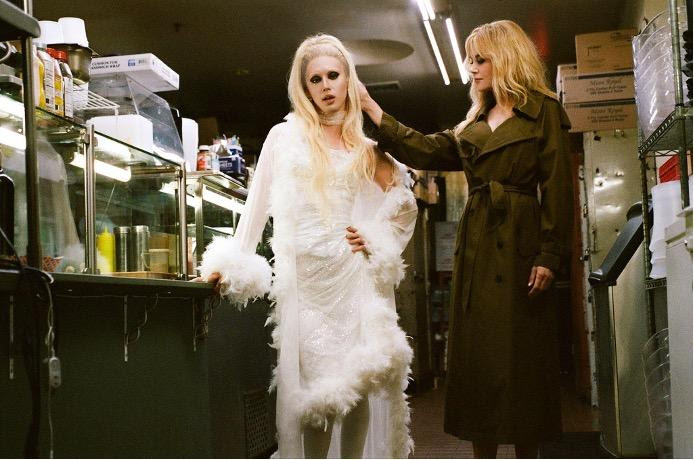
There is something almost disciplinary about that juxtaposition. Here is the goddess, but don’t get carried away. Here is the extraordinary woman, but remember that somebody came on her dress. Put her on the pedestal, pedestal, pedestal, but make sure everybody understands from the beginning that she is not beyond sexual degradation either.
Imagine reversing that power dynamic. Imagine a woman making a supposedly affectionate music video about gay men and introducing its idealized male character through an image intended to tell us that another man had ejaculated on his clothing. Then imagine that throughout the video most of the gay male characters were presented as exhausted, poor, anonymous, sexually promiscuous or visually disposable, while one impossibly glamorous man received the filmmaker’s sustained attention because he eventually possessed something the female protagonist needed from him.
Would gay male viewers who objected be told they simply didn’t understand the humor?
I doubt it.
So why should women look at “She’s the Best,” see women reduced to sexual and social archetypes, hear the woman at the center of the fantasy introduced through semen on her clothing, and interpret the entire thing as an uncomplicated love letter to femininity?
As a femme lesbian, this is where the disconnect becomes particularly difficult for me to ignore. Loving women is not the same as collecting symbols of femininity. Femmes know that femininity can be theatrical, exaggerated, sexual and playful while still belonging to the woman embodying it. Lesbians know that attraction to women does not require turning women into raw material for somebody else’s self-discovery. I can love a woman, desire a woman, admire how she looks and still understand that she has an interior life that does not exist for me.
That is why the visual hierarchy here irritates me so much. The problem is not Sivan wearing feminine clothing. The problem is that his protagonist receives enormous interiority in exploring what femininity means to him while so many women surrounding that exploration receive comparatively little interiority themselves. Their womanhood becomes material through which he can think, desire, fantasize and eventually transform.
That isn’t automatically feminist because the material happens to be feminine.
And I’m increasingly tired of women becoming timid about saying things like that because we can already anticipate the accusation before we finish the sentence.
That frustration extends beyond this video. Women, lesbians and femmes have spent decades showing up inside LGBTQ communities. We have protested beside people. We have voted with other people’s rights in mind. We have raised money, donated to GoFundMes, offered couches and spare rooms, helped people find work, brought food, built community, held hands through medical crises and defended people’s right to live openly and safely even when the particular battle did not directly concern our own bodies. I have watched women provide enormous amounts of emotional, political and material labor to people we love because that is what solidarity is supposed to mean. You show up when somebody else’s rights are threatened because eventually everybody needs somebody to show up for them.
What I increasingly find myself asking is where that same urgency is when the threatened body is female.
Where is the sustained cultural attention to women confronting reproductive-health emergencies? Where is the outrage when abortion restrictions collide with miscarriages, ectopic pregnancies and other potentially catastrophic complications? Where is the same energy around women’s wages, careers, medical autonomy and civil rights?
There are LGBTQ people and organizations fighting those battles, of course, and as a lesbian I am certainly not going to pretend that “women” and “the LGBTQ community” are two separate populations. Lesbians are women. Bisexual women are women. Trans women are women. Plenty of gay men and other queer people are fierce advocates for reproductive freedom and women’s equality.
But in the online spaces I have been watching, the imbalance in attention has become impossible for me not to notice. I hear endless discourse about what women are supposed to call people, whom women should be willing to date, what women should validate, what women should accommodate and which language women should use. Meanwhile, some of the most frightening material threats facing women can receive comparatively little oxygen.
That is why “She’s the Best” landed so badly for me. I am already exhausted by being told how much everybody supposedly loves women while watching actual women’s needs become secondary. Then I watch a video announcing its admiration for women and encounter female bodies reduced to sex, exhaustion, age, anonymity and spectacle. Even the woman placed highest on the pedestal is introduced through semen on her clothing before eventually becoming useful to the protagonist’s own transformation.
The project tells me how much it adores femininity while I am sitting there wondering whether it is particularly interested in women when we are not useful, inspirational, sexually provocative or aesthetically legible.
And this is where I want the distinction between women and the aesthetics associated with femininity taken seriously. Womanhood is not breasts, long hair, eyelashes, nails, makeup or dresses. Those things can be expressions of femininity. They can be fun, meaningful, beautiful, erotic or important to the people who choose them. But they are not the sum total of a woman’s life, and presenting them as though they somehow define womanhood feels particularly offensive when you consider how most women in the world actually live.
I guarantee you that women living under Taliban restrictions in Afghanistan, women doing agricultural labor, and the immigrant, Asian, Latina and Hispanic women I have known working in factories, farms and fields, some continuing physically demanding work into middle and senior age, have considerably more consequential things defining their lives than breast implants, hair extensions, false eyelashes and acrylic nails. Many women around the world will never have access to those luxuries at all. There are women in my own family who worked into their eighties. I have personally known women whose understanding of womanhood was forged through decades of labor, motherhood, survival, family, aging, sacrifice, responsibility and simply keeping everybody around them alive and moving forward.
So I do not want to be lectured about womanhood through an aesthetic vocabulary overwhelmingly associated with beauty, consumption and access to money. There is something almost obscene to me about extraordinarily privileged people, with access to expensive fashion, cosmetic procedures, stylists, private medical care and virtually every tool modern beauty culture can provide, presenting the purchasable accessories of femininity as though they reveal some profound truth about what it means to be a woman. They reveal one way of presenting femininity. That is all. They do not tell me anything about the woman picking crops in extreme heat, the woman working a factory line into her sixties, the woman cleaning somebody else’s home, the woman raising children while working two jobs, or the elderly woman who spent her entire adult life doing physical labor and never once had the luxury of wondering whether her eyelashes adequately expressed her womanhood.
This is also why reducing the argument to who can perform femininity most spectacularly feels so grotesquely class-blind to me. Beauty at this level costs money. Hair costs money. Nails cost money. Cosmetic surgery costs money. Designer clothing costs money. Professional makeup costs money. Time itself costs money. The ability to construct an immaculate version of femininity can be a direct expression of wealth and access, not evidence that somebody understands womanhood more deeply than a woman whose hands are calloused from forty years of work. The latter woman is not somehow an incomplete or less interesting woman because she has never had extensions, implants, acrylics or a professional glam team.
There are physical, social, economic and political realities attached to women’s lives that cannot be reduced to an aesthetic.
Reproductive healthcare is not an aesthetic. Pregnancy complications are not an aesthetic. Female poverty is not an aesthetic. Aging in a female body is not an aesthetic. Working until your body hurts because your family needs the money is not an aesthetic. A woman frightened about what will happen to her during a medical emergency does not become more visible because somebody with vastly greater resources has written another song telling her how fabulous women are.
That is the contradiction I am tired of. Stop telling women how extraordinary we are while talking over us. Stop calling us powerful while treating our boundaries as moral defects. Stop confusing an expensive performance of femininity with the lived reality of being a woman. Stop celebrating an abstract idea of Woman while finding actual women inconvenient when we disagree, age, struggle, set limits or ask somebody else to advocate for us for once.
Solidarity cannot mean women are expected to give endlessly while being frightened into silence the moment we ask whether anybody is giving something back.
That matters because online conversations involving women, sex, dating, gender and boundaries have become increasingly hostile toward women who refuse to say exactly what strangers want them to say. Women discussing dating preferences involving bisexual men can find themselves accused of homophobia, sometimes with little distinction between actual anti-bisexual prejudice and an individual woman’s right to decide whom she dates. Women discussing sex-based protections, or objecting to language they believe minimizes their own experience of womanhood, can find themselves branded TERFs before anyone bothers to engage with what they actually said.
Real homophobia exists. Real biphobia exists. Real transphobia exists. They hurt people and deserve to be challenged. But acknowledging that cannot require women to surrender our own autonomy.
A woman’s consent is not an equal-opportunity program. Nobody is owed attraction. Nobody is owed a date. Nobody is owed sex. Nobody is entitled to somebody else’s body because being rejected might produce an uncomfortable political conversation. A woman’s “no” does not become morally defective because somebody else can attach an ugly label to her for saying it.
Nor should women have to consent intellectually to every idea about womanhood presented to us. Women are allowed to describe our own experiences. We are allowed to disagree. We are allowed to have boundaries. We are allowed to criticize art supposedly made in celebration of us. We are allowed to say, “I find this degrading,” without spending the next thousand words establishing that we harbor no hatred toward every identity represented somewhere in the production.
As a femme lesbian, I find that expectation particularly frustrating because I am not standing outside the LGBTQ community throwing rocks at it. I am part of it. Lesbians are part of it. Women have always been part of it. And I refuse the suggestion that belonging to this community requires me to remain silent when something coming from inside that same community strikes me as misogynistic.
I am increasingly sick of women being expected to perform that ritual before we speak. You know the calculation. Is the artist gay? Is somebody involved trans? Will I be called prudish? Will I be accused of homophobia? Will somebody call me a TERF? Will one sentence be screenshotted, stripped of every qualification around it and circulated as evidence that I secretly hate an entire community?
At some point, fear of “the mob” becomes another mechanism for telling women to shut up.
Being marginalized in one respect does not make somebody incapable of misogyny. A gay man can hold misogynistic ideas. A woman can be homophobic. A lesbian can say something offensive about another part of the LGBTQ community. A straight person can be an extraordinary advocate for LGBTQ rights. People are complicated. Identity is not diplomatic immunity from criticism, and criticizing one gay artist’s work is not an attack on gay people.
I am particularly tired of the suggestion that vulgarity directed toward women must somehow be understood differently when it comes wrapped in queer aesthetics.
Women have heard this argument before in different clothes. For generations, women who objected to degrading sexual jokes were told they simply did not understand them. We were humorless, uptight, frigid, prudish, repressed, too old-fashioned to understand sexual liberation or too unsophisticated to appreciate transgression. I am not interested in reenacting that arrangement with updated terminology.
If your ode to women begins with semen on a woman’s dress, women get to ask what the fuck you are doing.
And compliments do not cancel it out. You cannot necessarily say something degrading about women, surround it with enough declarations about how fabulous and powerful women are, and call the entire package empowerment.
The abstract Woman is easy to worship because she never talks back. She never disagrees with your interpretation of her. She never establishes a boundary. She never says, “Actually, I don’t like the way you’re talking about me.”
Real women do.
Then “She’s the Best” becomes stranger still because Sivan eventually enters the video’s heightened vocabulary of femininity himself. Again, his feminine presentation is not what bothers me. Queer artists have every right to use art to investigate themselves. What interests me is the narrative context in which this happens.
Sivan spends much of the video studying Kidman. She exists as the ideal at the center of the film, observed with a fascination that can read as attraction, aspiration and something almost maternal. He does not simply morph into her. The ending is stranger than that. Kidman seems to occupy something closer to a “birthing” (UGH) role, a figure involved in bringing this heightened feminine version of Sivan into existence.
Suddenly, the pronoun at the center of “She’s the Best” becomes considerably more interesting.
What if at least some of the praise is directed inward? What if “she” is not exclusively an external woman Sivan admires, but also an idea of femininity through which he is exploring another version of himself?
I cannot know that, and a music video does not give me permission to declare anything about Sivan’s private identity. I am talking about the narrative he chose to put onscreen. But if self-identification with the feminine ideal is part of the conceit, there is something almost spectacularly narcissistic about it. Construct an entire song around how extraordinary “she” is. Populate its visual world with representations of women. Spend the video worshipping an impossibly glamorous female ideal. Then ultimately place yourself inside the femininity you have spent the song praising.
Maybe that is intentionally funny. Maybe it is personal. Maybe it is about vulnerability or discovering qualities within yourself through someone you admire. Art has always given people room to investigate themselves indirectly.
But women are still allowed to ask an uncomfortable question: At what point does celebrating femininity become using women and womanhood as raw material for somebody else’s self-discovery?
That question is particularly difficult for me to ignore because the material reality of being a woman in America right now is anything but an aesthetic exercise. Women are navigating a country where reproductive healthcare and abortion access can depend dramatically on geography. Pregnancy complications can collide with legal restrictions. Bodily autonomy remains a political battleground.
There is nothing theoretical about that. There are no feathers. There is no immaculate lighting. There is no fabulous soundtrack playing while a woman wonders what medical care she can receive during a pregnancy emergency.
So when pop culture announces that it is celebrating women, I think women are entitled to look at that celebration and ask whether it recognizes us as human beings or merely loves the aesthetics associated with us.
Strangely, that brings me back to what interested me about “She’s the Best” before the video made me angry.
Social media has fundamentally changed the size of the musical object people consume. A song can become seven seconds of itself. It can become a transition, punchline, makeup reveal, dance, breakup video, fashion montage, meme, advertisement or CapCut template. Millions of people can recognize a fragment without knowing the artist or anything that happens thirty seconds before or after it.
Dance culture understood part of this decades ago. DJs have always treated recordings as material capable of multiple lives. Charli XCX’s Brat embraced mutation until remixing itself became part of the artistic statement. KATSEYE’s music and choreography similarly understand the grammar of internet video, where a movement, rhythmic shift or visual cue can remain useful when separated from the complete performance.
Maybe “She’s the Best” understands that too. Maybe its spoken passages and affirmation-like construction intentionally leave room for other people to rebuild it.
But after watching the video, I realized something else.
The song fragments language. The video fragments Woman.
Sex. Glamour. Exhaustion. Age. Vice. Dance. Poverty. Fantasy. Beauty. Motherhood. Transformation.
Womanhood becomes a collection of instantly recognizable signs that can be selected, exaggerated and rearranged. Suddenly my discomfort with the music and my discomfort with the video seem connected.
Maybe everything is becoming source material.
There is a difference between exploring femininity and assembling its most recognizable symbols into an aesthetic. There is a difference between celebrating women and finding Woman useful as inspiration. There is a difference between representation and extraction.
I do not know what Troye Sivan intended. I know what I felt watching it.
I felt insulted.
Not because the video contains gay men. Not because it contains trans women. Not because it contains drag, burlesque, sex or unconventional femininity. I felt insulted because something presented as an ode to women repeatedly showed me versions of female existence that I experienced as degraded, exhausted, sexualized, anonymous or impossibly idealized, and then seemed more interested in what femininity could mean for its male protagonist than in the interior lives of the women supposedly being celebrated.
Maybe another woman will watch it and feel seen. She gets to say that.
I get to say this.
As a femme lesbian, I refuse the idea that criticizing misogyny somehow requires me to stand outside my own community. Women are part of the LGBTQ community. Lesbians are not an inconvenient footnote to it. And solidarity cannot require us to surrender our voices when the thing making us uncomfortable comes from inside the house.
Women are not an aesthetic. We are not semen on a dress. We are not anonymous legs in somebody else’s choreography. We are not an exhausted commuter, a sexual tableau, an impossibly glamorous muse, a political thought experiment or a collection of feminine signifiers waiting for somebody else to discover himself through them.
Please stop offending women and then expecting our fear of being called something worse to keep us quiet.
If a vision of liberation requires women to be afraid to criticize it, it is not liberating women.
I started “She’s the Best” wondering whether I was hearing music for art’s sake, music for the artist’s sake or music for the internet’s sake. After watching the video, that question feels almost quaint.
The one I cannot stop thinking about now is much simpler:
If this is what celebrating women looks like, when do women get to speak for ourselves?
Featured image credit: Troye Sivan